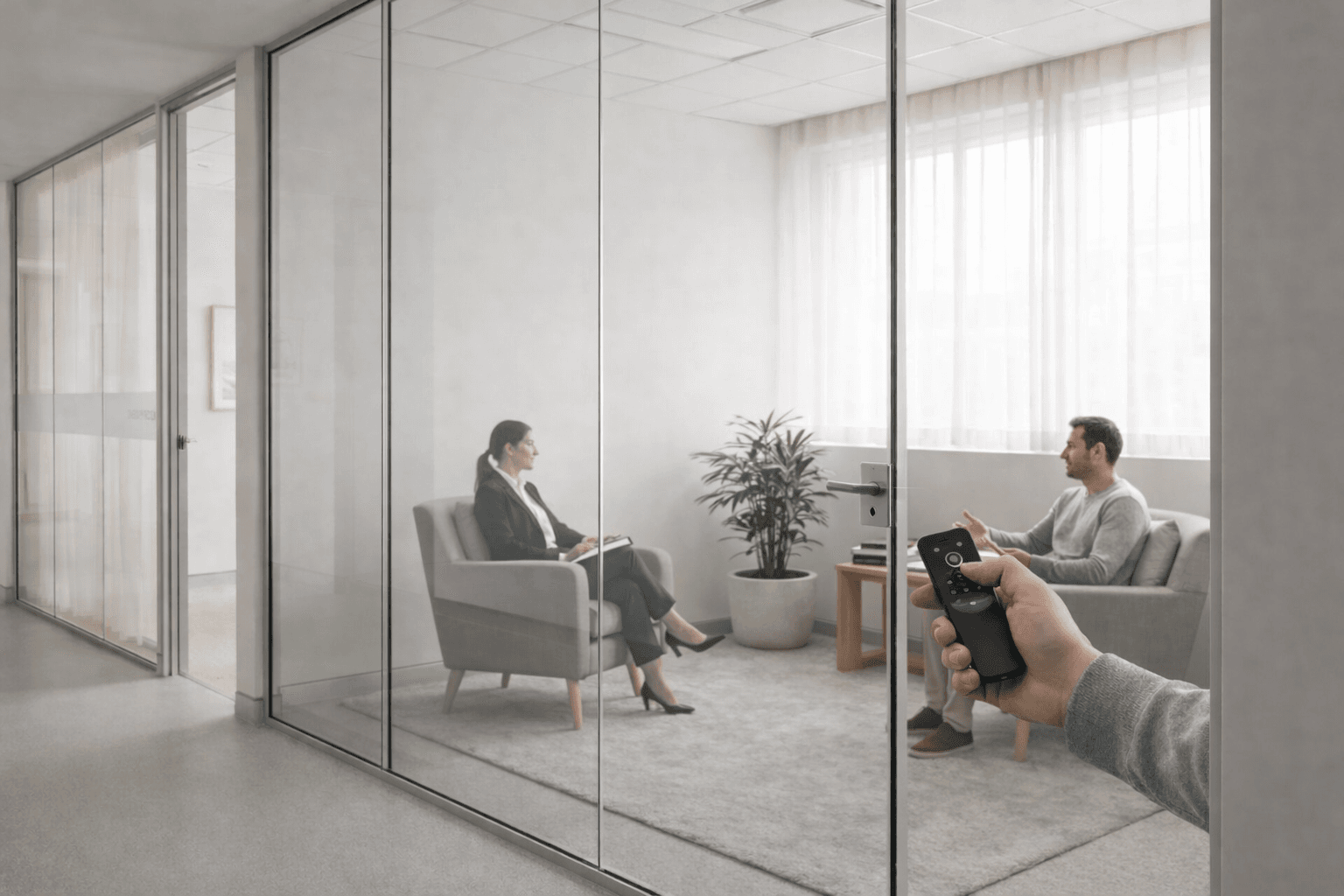
PDLC smart film looks simple after installation: apply power and glass becomes clearer; remove power and it returns to a frosted privacy state. Producing a reliable project system, however, involves material engineering, controlled processing, electrical preparation, compatible drivers, inspection, and careful handling.
This overview explains the main stages without relying on proprietary formulations that vary between manufacturers.
The Functional Layer
PDLC stands for Polymer Dispersed Liquid Crystal. The active layer contains microscopic liquid-crystal droplets distributed through a polymer matrix. This layer sits between transparent conductive surfaces.
Without the specified electrical field, the droplets are not uniformly aligned and incoming light scatters, creating the frosted appearance. With the correct field applied, the droplets align more consistently and more light travels through in the forward direction, creating the clearer state.
The optical result depends on formulation, layer uniformity, conductive films, lamination or coating control, and the driver used with the finished film.
Conductive Substrates and Layer Assembly
Transparent conductive substrates carry the electrical field across the active area. Cleanliness and uniformity are important because contamination or process variation can become visible across the finished panel.
Manufacturing conditions must control coating, curing, bonding, and handling. Exact methods differ by product and manufacturer, but the objective is consistent optical and electrical behaviour across the usable film width.
Conversion Into Project Sizes
Master material is converted into rolls or custom pieces. Conversion planning considers available width, orientation, panel dimensions, electrical connection location, cutting allowance, and protective handling.
For custom project supply, approved drawings or panel schedules reduce errors. Each piece can be labelled to connect it with a specific room or glass panel.
Busbar and Electrode Preparation
The busbar distributes electrical output into the film's conductive layers. Its construction and position affect connection reliability and installation detailing.
Preparation requires controlled access to the correct conductive layers, suitable conductive materials, insulation, strain relief, and a planned cable exit. Site teams should not improvise this stage without product-specific training.
Shreesha Tech now manufactures the busbar chemical used in this stage in-house in India, rather than importing it as many suppliers still do. Read why in-house busbar chemical matters.
Shreesha Tech supports project-ready film preparation along with compatible power supplies and control hardware, helping coordinate the complete operating system.
Matching the Power Supply
The driver converts incoming electrical power into the output required by the PDLC film. It must be matched to the film type, total connected area, zoning, and control method.
An installation may use a wall switch, remote, mobile application, voice assistant, timer, sensor, or building-automation relay. These controls should operate through an approved system architecture; they should not expose the film to unsuitable mains power.
Quality-Control Checks
Quality checks can occur at material, conversion, assembly, and final-dispatch stages. Depending on product and scope, checks may include:
- Surface and contamination inspection
- Clear and frosted visual inspection
- Uniform switching test
- Electrical connection and insulation check
- Dimension and label verification
- Driver and control function test
- Protective packing inspection
For large or repeat projects, traceability helps identify the material and preparation associated with each dispatch.
Packing and Storage
Finished film must be protected from folding, pressure, sharp impacts, dust, moisture, and unsuitable temperatures. Custom pieces should remain flat or be packed according to the manufacturer's instructions. Labels should be readable without unnecessary unpacking at site.
Storage and handling instructions remain important after delivery. Material should not be left in uncontrolled site conditions while other construction work produces dust, heat, or moisture.
Installation Completes the Manufacturing Chain
Even well-produced film can perform poorly if the glass is contaminated, the film is creased, edges are left vulnerable, or electrical connections are incorrect. Successful delivery therefore connects factory quality with installation quality.
The project team should verify glass readiness, approved cleaners and sealants, cable routing, driver location, electrical zones, edge protection, and commissioning procedures before installation begins.
Questions to Ask a Manufacturer
- Which stages are performed or controlled in-house?
- How are custom dimensions and busbar positions approved?
- How is switching checked before dispatch?
- Which driver is approved for the quoted film?
- How are pieces identified and protected in transit?
- What installation documentation and support are provided?
- How are warranty or replacement cases traced?
Understanding the complete process makes it easier to distinguish a project system from a simple material quotation. Explore our PDLC product solutions or contact Shreesha Tech to discuss manufacturing, controls, and supply for your project.