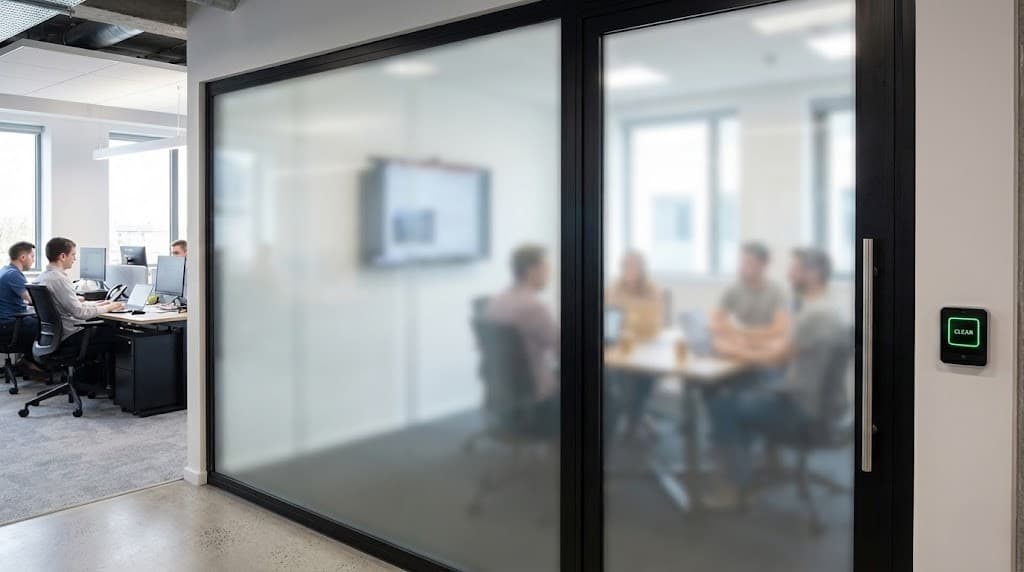
A powered sample is one of the best ways to evaluate PDLC smart film before approving a manufacturer or supplier. The test should go beyond watching the film switch once. Optical performance, privacy, uniformity, surface condition, electrical compatibility, and documentation all matter.
Use the same lighting, background, viewing distance, and test method when comparing samples from different suppliers.
1. Confirm the Exact Product
Record the product name, construction, colour, thickness, sample date, and supplied driver. Ask whether the sample represents the same product and production specification that will be supplied for the project.
2. Inspect the Surface Before Powering
Under angled light, look for scratches, pressure marks, contamination, bubbles, edge damage, or visible coating variation. Some marks may come from sample handling rather than production, so document the condition when it arrives.
3. Check Frosted-State Privacy
Place a person or printed target behind the unpowered sample. Test at several distances and with different lighting on each side. Privacy can change when a subject stands close to the glass or when the room behind it is brightly lit.
For bathrooms, clinics, or confidential rooms, recreate the actual viewing condition as closely as possible.
4. Evaluate Clear-State Haze
Power the sample using only its approved driver. View nearby text and a distant detailed object through the film. Look straight through and from both sides at several angles.
PDLC is a switchable privacy technology rather than invisible ordinary glass, so some optical difference may remain. The important question is whether the appearance is suitable for the intended application.
5. Observe Switching Uniformity
Switch the sample repeatedly and watch the entire active area. The transition should appear consistent without obvious inactive zones. Check edges and the area around electrical connections carefully.
6. Listen and Inspect the Driver
Identify the driver model and rated capacity. During a short demonstration, note unusual noise, smell, heat, or unstable operation. A complete project assessment should be performed by qualified technical personnel using the manufacturer's requirements.
7. Test the Intended Control Method
If the project requires a remote, mobile app, dimming, voice command, sensor, or automation relay, test that control path rather than assuming compatibility from a basic switch demo.
8. Compare Day and Night Conditions
Daylight can hide or emphasize different optical characteristics. Repeat the privacy and clarity checks under strong ambient light and after dark with interior lights on. Exterior-facing glass especially needs this comparison.
9. Review the Busbar and Cable Exit
Inspect how the electrical connection is prepared and protected. Ask how this detail changes for full-size panels, where it will sit in the frame, and how installers should provide strain relief and edge protection.
10. Request the Current Datasheet
The physical test and written data should support each other. Review transmission, haze, operating requirements, power consumption, temperature limits, dimensions, and storage instructions. Read our PDLC specification guide before comparing numbers.
11. Ask About Installation Materials
Confirm approved cleaning products, sealants, edge treatments, wiring accessories, and glass conditions. If self-adhesive film is being applied to existing glass, inspect that glass for coatings, damage, silicone contamination, and access constraints.
12. Test the Supplier, Not Only the Film
Notice whether the supplier asks about dimensions, environment, controls, and installation. Request a written quotation that defines included accessories, preparation, delivery, installation, warranty, and support.
A good sample with an incomplete project scope can still lead to a poor result. Technical communication and after-sales responsibility are part of product quality.
Simple Sample Evaluation Record
Create a table for every sample with the following fields:
- Supplier and product reference
- Sample construction and size
- Driver reference
- Clear-state visual result
- Frosted privacy result
- Angle and lighting observations
- Switching uniformity
- Surface and edge condition
- Control compatibility
- Datasheet received
- Commercial scope received
- Final decision and approver
From Sample to Project Approval
For larger projects, move from a handheld sample to a full-size mock-up using the actual glass, framing, edge treatment, controls, and room lighting. Approve the mock-up in writing before bulk conversion or installation.
Shreesha Tech provides PDLC smart film samples, technical guidance, compatible controls, and project supply across India. Request a sample or live demonstration and share your intended application so the test reflects real project conditions.