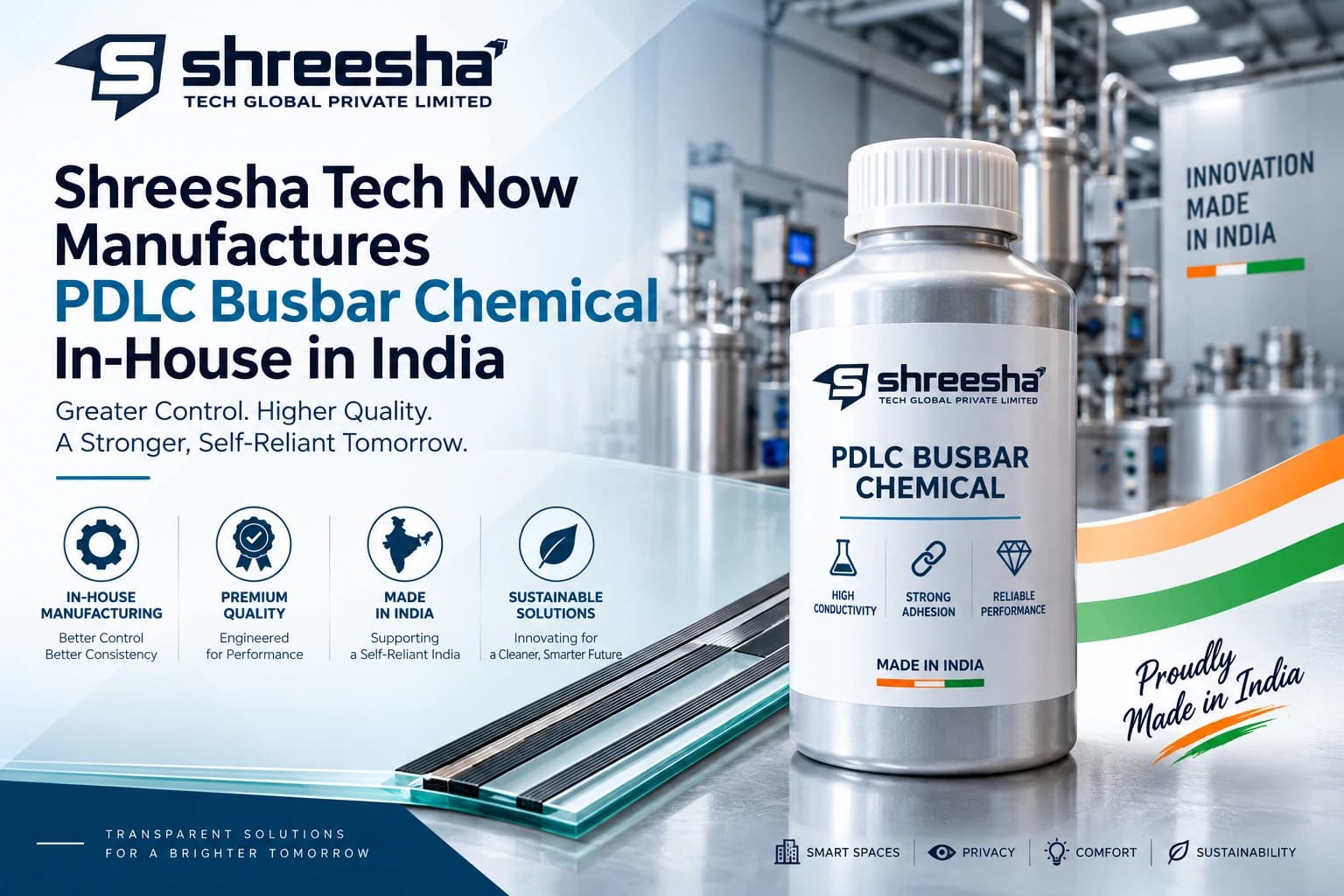
A PDLC smart film system is only as reliable as the electrical path that switches it. The busbar—and the conductive chemical used to form it—is one of the least visible parts of that path, and one of the most important.
Until now, much of the Indian PDLC market has depended on imported busbar chemical from China. Shreesha Tech has added in-house manufacturing of busbar chemical at its India facility, so film preparation no longer has to wait on overseas paste, freight, and batch variation.
This article explains what busbar chemical is, why import dependence is a project risk, and what in-house production changes for fabricators, distributors, and project owners.
What Is PDLC Busbar Chemical?
PDLC film switches when an electrical field is applied across its transparent conductive layers. That field has to enter the film through a busbar along the edge of the panel.
Busbar chemical is the conductive paste, adhesive, or similar compound used to create a stable electrical interface between the film's conductive coating and the connection that leads to the power supply. Without a well-formed busbar, even high-quality film can show:
- Uneven or slow switching
- Hot-spots or weak zones near the edge
- Intermittent connection after handling or thermal cycling
- Failures that look like “film problems” but start at the electrode
Busbar position, width, adhesion, and conductivity should be planned with panel size, cable exit, and driver matching. See also our overview of how PDLC smart film is made.
Why Most Suppliers Still Import It
In India, many PDLC traders and even some converters still buy busbar chemical from Chinese sources and apply it during cutting and electrode preparation. The film may be marketed as a local product, while a critical process chemical remains an import.
That model can work when shipments are regular. It becomes a problem when:
- Lead times stretch and project cutting is delayed
- A new imported batch behaves differently from the last
- Customs, logistics, or currency movement changes cost with little warning
- Site teams cannot get a fast replacement of prepared pieces
- Quality issues are hard to trace because the chemical source sits outside the supplier's factory
Importing a finished roll is one kind of dependency. Importing the chemical that makes every custom panel electrically usable is another—and it sits on the critical path of almost every project order.
What In-House Manufacturing Changes
Shreesha Tech now produces busbar chemical in-house instead of relying on that China-import route. The aim is not a slogan. It is control over a material that every custom-cut PDLC piece depends on.
In practical terms, in-house manufacture supports:
Supply that follows the project, not the shipping line
Film conversion, busbar preparation, and dispatch can be planned together. Custom sizes do not stall because a drum of imported paste has not cleared port.
Tighter batch consistency
When the chemical is made and used in the same manufacturing system, adhesion, conductivity, and application behaviour can be checked against the film and drivers Shreesha Tech actually supplies. That is harder when each imported lot comes from a distant vendor with limited process visibility.
Faster technical feedback
If a connection, climate, or handling issue appears, the materials team and the film team are in one organisation. Buyers are not left between an Indian seller and an overseas chemical mill.
A deeper Make in India stack
Shreesha Tech already manufactures and supplies PDLC smart film, power supplies, control hardware, and busbar preparation. Producing the busbar chemical locally closes another imported gap in the same system. Project teams get one technical point of contact instead of a chain of traders.
Why This Matters on Indian Sites
Indian installations see heat, humidity, mixed glass types, tight programmes, and handling between factory, transporter, fabricator, and site electrician. A busbar that looks acceptable in a lab but lifts, cracks, or loses conductivity after transit is a warranty event waiting to happen.
Local chemical manufacture does not replace correct installation. Dust, unapproved sealants, poor cable strain relief, and mismatched drivers still cause failures—see our installation mistakes to avoid. It does mean the electrode material can be specified, produced, and tested for the same operating conditions as the film and the driver.
How Buyers Should Evaluate a “Local” PDLC Manufacturer
“Made in India” on a brochure is not enough. Ask where each critical input comes from:
- Is the busbar chemical manufactured in-house, or imported and only applied locally?
- Who approves busbar position, width, and cable exit for each panel?
- How is electrical continuity checked before dispatch?
- Which power supply is matched to the prepared film?
- If a connection fails, is replacement handled by the same factory that made the chemical and prepared the film?
A supplier that imports the chemical from China can still cut film in India. The difference shows up in lead time, consistency, and who owns the process when something goes wrong.
For a broader factory-direct checklist, read our PDLC manufacturer buying guide.
What This Means for Distributors and Fabricators
Channel partners often lose days waiting for prepared panels or for a consumable that is stuck in import. In-house busbar chemical helps Shreesha Tech keep project-ready film preparation on an Indian production calendar.
It also supports:
- More predictable custom-cut programmes
- Clearer quality ownership on electrode work
- Less exposure to a single overseas chemical source
- A stronger story for clients who specify domestic manufacturing
Distributors evaluating a long-term line can also review our distributorship guide.
Final Takeaway
The busbar is the film's electrical doorway. The chemical that forms it should not be an afterthought imported by default.
Shreesha Tech now manufactures PDLC busbar chemical in-house in India, rather than depending on the China-import model still common in the market. Combined with local film supply, power supplies, and controls, that gives architects, fabricators, and project owners a more complete domestic system—and a factory that can stand behind the connection, not only the square footage.
To discuss custom sizes, busbar layout, and matched drivers, contact Shreesha Tech with your glass dimensions, city, and application.